
The Bin Laden Memorial
From the archives

The Bin Laden Memorial was originally published by the Radical Capitalist in January, 2002. At that time, the future use of New York's Ground Zero was a matter of heated debate, with virtually all mainstream voices calling for some kind of vast memorial.
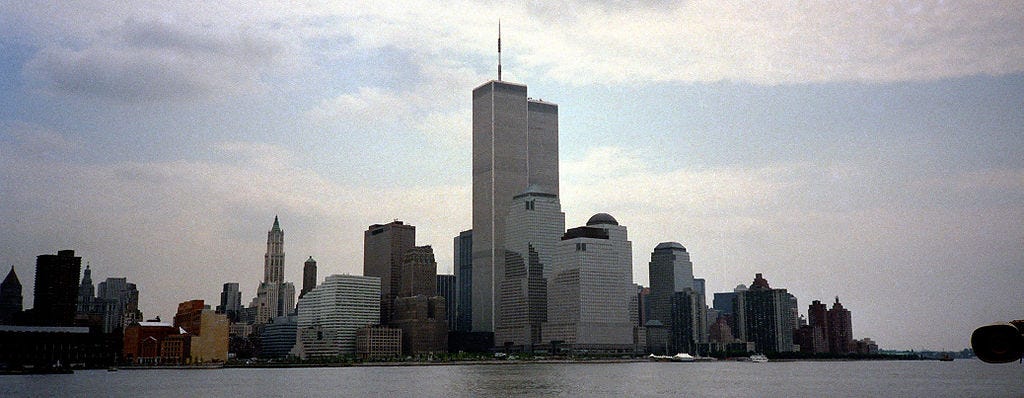

The professional mourners want to erect a shrine where the Twin Towers used to stand.
The professional mourners are the consolers and High Hand-holders of all faiths. They are of no use to happy, confident men, but in tragedy they find employment and even acclaim for uniting rich man and poor man to contemplate the meaning of life in the context of death. No horror is so unexpected that they are not ready with a chorus of "Amazing Grace." They sing "we shall overcome someday," always with the emphasis on someday. They share with Allah's martyrs the belief that an individual's true value is to be found at the time of his death.
None of the professional mourners has, to my knowledge, suggested erecting their shrine on private funds. But even if they did, there is no good reason to sell it to them; there is no good reason to replace the World Trade Center with a September 11 memorial. Our memory of the dead will not fade because there is no pyramid where they died.
I anticipate several objections. I expect, for instance, to hear it claimed that the fallen heroes of the police and fire departments deserve such a memorial.
In fact, they deserve better. Their job was to protect the World Trade Center and keep its occupants safe. They died on that job when they could have run uptown or across the river. By rebuilding on the site, we act according to their final wishes; by evacuating the site, we act according to bin Laden's.
Others object that the deaths at the site have made the ground sacred - "hallowed" - and therefore off-limits to activity not consonant with kneeling and mumbling. This objection asserts a subjective sense of the sacred as if it were a reality more valid than objective reality, and demands the medieval form of reverence for the graveyard; to wit, forbidding the business of the living for fear of annoying the dead. By calling the ground "hallowed," and refusing to explain myself further, I imply that I have a reverence for my country and/or the fallen, and that, by the way, if you keep pressing me to defend my position you are probably not a serious person, and maybe even a casual blasphemer.
The astute observer will have noticed that the hallowers' motivated core consists of luddites, and its rank-and-file of dilettantes. The luddites possess already an enmity for the business of living; an enmity now masquerading as reverence for the dead. What has happened to the New Yorkers and out-of-towners who thought that cities, particularly big cities, particularly skyscrapers in big cities, were blights on God's landscape canvas? Who always thought that the site of the World Trade Center would have been better used as a public park? They have become sisters in the Order of the Eleventh. What has happened to their canards about sunlight deprivation and the starry summer nights hidden from the city-dweller's view? They have been thrown over for a better rationale. They have been thrown over for "hallowed ground."
If you doubt the strength or even the presence of the luddites among the hallowers, then consider: what is it precisely that makes Ground Zero sacred?
I do not ask this question lightly. I believe that "sacred" denotes a valid concept, if by "sacred" you mean "deserving of reverence." But I would like to hear the theory of death that makes it a consecrator of the soil upon which it occurs. And once I have heard the theory, I am likely to ask why it is that every death does not possess whatever power its fans attribute to the deaths that occurred last September. If the site is hallowed because 3,000 died there, why wasn't it already hallowed because 6 died there in the bombing of 1993? Is it the sheer number? -- Or is it that the bombers in 1993 were unsuccessful? Calling the ground hallowed is not enough to get your fellow-citizens to voluntarily relocate and demolish their tall buildings. But it might be enough to keep them from rebuilding structures already in ruins.
The best argument the hallowers could concoct (although I have not heard it from them) is that Ground Zero is sacred because some individuals died there performing confirmable acts of heroism. This is the best argument, because the heroism of the cops and firemen makes the event at least ostensibly unique for the site, and because heroism unto death reveals the ultimate integrity, and tales of the ultimate integrity are proof that man - even modern man - has the capacity for glory in the classical sense; proofs against the cynic and the aesthetic naturalist. As I say, this is the best argument for hallowing the downtown ground, which means that it is the best of some very specious arguments. There are still a million miles of broken links between the plaque that reads "A hero died here" and the one that reads "A hero died here. - No trespassing."
The dilettantes will hallow the ground to salute the dead for the same reason they hold hands across America to cure hunger. It is a combination of low-risk grunt work and hype intended to replace the kind of effort they dread the most. - Cognitive effort. Anyone who knows the story of a Ground-Zero hero, and who believes the story should be told, should tell it. He should write the article, the book, the play. Found the foundation. But including a name among 3,000 other names on a stele in downtown Manhattan is a tribute only to the dilettante's willingness to invent something even smaller when the very least he can do is still too much.
In case you still doubt my assessment of the hallowers' motives, consider which activities will not be prohibited on this site, taking New York's other city parks and landmarks as a guide. The hallowed site will still be trodden by the living. Bums will invade it, horses will defecate in it, the phlegmatic will spit on it. It will be open to the public, after all, and it is a civil right of the dregs Americana to make any public park their pied-a-terre. The one activity that almost certainly willbe prohibited is the activity that the victims were engaged in at the time of their deaths; that is, making a living in private enterprise. No buying or selling will be permitted at the Bin Laden Memorial. After all, Jesus purged the temple of the moneylenders, not of the codependent marchers in a Pride Day parade.
In brief, the medieval notion of ground made sacred is accepted and repeated by luddites and dilettantes, whose true motives will not endure scrutiny.
Others object that not erecting a memorial in place of the World Trade Center is the equivalent of turning our backs on history: of intentionally "not remembering." We must remember what happened so that it will not happen again, the argument goes.
I do not argue with the proposition that Americans must remember the attacks of September 11; specifically, that Americans must understand the fundamental conflict of values that it represented and still represents. But there are another million miles of broken links between remembering an abomination and erecting a "soaring memorial" (to use Mayor Giuliani's term) to commemorate it. Shrines have always been top-heavy information media, but prior to the inexpensive dissemination of printed text, they - along with other primitive media, such as ballads and oral chronicles - were the means of communicating historical events. Pyramids, steles, cathedrals, tombs, all conveyed information for future generations of the era in which they were created. Often this communication with future generations was intentional and elaborate. But the typical Egyptian who lived at the time the pyramids were built got his information from traders, soldiers, and the readers of the pharaoh's edicts; in short, anyone who brought information to him . Had he relied on the hieroglyphs at Abydos to teach him the lessons of history, he would have known nothing of them at all. Seeing these tombs and shrines would have meant putting down his plough and traveling days, weeks, or months to reach his destination. Then, even assuming he was literate (and literacy was a privilege of the priesthood) he would have spent more days, weeks, or months studying the inscriptions.
The invention of the printing press, and the subsequent availability of inexpensive volumes of printed text, did far more to inform the literate masses than any landmark anywhere at any time. News of the world, printed in London, could be carried to every part of the Empire. Yesterday's news and historical comment were available in books. Schools used books to educate the young.
If landmarks were never good stores of information for the present, and if the printed word made them obsolete as stores of knowledge for the future, photography, motion pictures, documentaries, and the distributed terabytes of raw information driving the Internet have killed and buried them.
Critics of this position often point to the long lines of tourists at historical landmarks as evidence of their contemporary relevance. In fact, these long lines prove that landmarks are utterly unnecessary to the remembrance of the events they commemorate. No tourist plans even a day visit to a landmark whose moment in history is unknown to him. That is, the long lines of tourists at landmarks are evidence - not of the landmarks' power, but of the power of the information media that made the tourist book the trip. Visitors to Pearl Harbor's museums already know of the Japanese sneak attack, and have come to the harbor in order to see the place where the famous event occurred. Even supposing the existence of a tourist to Hawaii who had never heard of the sneak attack, visiting one or all of the museums would leave him with only a vague idea of why it happened, and he would know less about how it happened than any homebound Scandinavian with a copy of Tora! Tora! Tora! on her nightstand.
The same is true for the restored concentration camps of the German Third Reich. At the site of Auschwitz-Birkenau stands a museum and a restored portion of the most infamous of the Nazi death camps. The museum contains all of the edifying materials: the documents, the photographs, and so on. The restored barracks are just grisly tourist attractions.
I know that the camps are, officially at any rate, preserved in order that visitors, chastened by the tour, may return to their own parts of the world better able to fight the occurrence of similar atrocities.
They have the opposite effect. Visitors make plans, board and debark airplanes, put up at hotels, then at last view the preserved site of the atrocities. They then take their memory of the low-risk grunt-work required to travel to the place, combine that memory with their visceral reaction to the artifacts of torture and humiliation, and substitute the compound for the intellectual work of determining how these artifacts came to be used on a daily basis by what was once one of the most civilized nations of Europe. They see where the gas pellets were dropped, shake their heads angrily at the people who let it happen, then check out of their hotels, board and debark airplanes, tell their friends about the evil Germans they now know all about, and vote for their local national socialist.
But the death camps at least had utility as a reminder at one time and in a limited context. Just after the liberation of the camp at Buchenwald, but before the stacked corpses of the victims could be taken away, General Patton rounded up the citizens of nearby Weimar and marched them through the camp so they could see with their own eyes the product of their moral cowardice and rationalizations. That day, the mayor of Weimar and his wife committed suicide. -- Maintaining the death camps as a scar on the lands of the former Reich was a form of retribution on the generation that made them a reality.
The Bin Laden Memorial will not have even this limited utility. The American government and its citizens were the targets, not the perpetrators, of the atrocity in Manhattan. Why compound the significant injury to this city and its people by forcing them to bear the cost and endure the sight of a Bin Laden Memorial?
Just after the attacks, Mayor Giuliani grasped the issue clearly: let our enemies change us - let them change the landscape of New York permanently - and they win a victory greater than perhaps even they expected. At a memorial service at Ground Zero a month after the attacks, he said, "We will dedicate the rebuilding of New York [to those who died in the attack] and [make] certain that we do not allow the terrorists in any way to break our spirit. Instead, they have emboldened it."
Who knows what whispers turned his head between that service and his farewell address last December, in which he suggested that New Yorkers would be better off dedicating the entire site - sixteen acres in downtown Manhattan - to some sort of memorial. Said Giuliani: "We have to be able to create something here that enshrines this forever and that allows people to build on it and grow from it."
"Enshrines it forever"? Bin Laden was surprised the buildings fell - He was only going for the top floors. Now, not only are the buildings gone and the neighborhood in ruins, but his enemy wants to take his handiwork and enshrine it forever.
Why enshrine it? So that we may "build on it and grow from it.".
It would appear, from his choice of words and change of heart, that he has been seduced by the over-rated ideal of unity. - Even unity in tragedy. It is the voice of the professional mourner again. People came together as a result of this tragedy. There is nothing warmer or more touching than people united in faith and a common knowledge of their shared mortality I.e. , there is nothing warmer than a hug at a funeral. If we can perpetuate the trauma, perhaps we can also perpetuate the unity. It is our new found unity that Giuliani wants to "build on" and "grow from."
He continues thus:
"This place [Ground Zero] has to become a place in which when anybody comes here immediately they're going to feel the great power and strength and emotion of what it means to be American."
This is how I felt about the World Trade Center and the Pentagon before they were attacked. The difference in what provokes these feelings in us lies in our differing definitions of "being an American." As Giuliani defines it, being an American means going to the funerals of other Americans. - Forever. As I define it, being an American means having the freedom to create and earn and to associate or compete with others doing the same, until our combined energies become the dynamo that sustains and extends the modernity of all aspects of human life. The Twin Towers were steel-and-glass expressions of a way of life that feeds, clothes, and makes life enjoyable for the rest of humanity; ornaments on the constructive explosion that is the unleashed energies of free individuals.
Rebuilding the towers - or structures better than the originals - does not cheat the heroes of their tribute, it is their tribute. If you want to commemorate the event of the attacks, put a plaque on the side of one of the buildings, and for an inscription write: "On September 11, 2001, a handful of tent-dwellers thought they could stop this."
The world that comes to this site will be far larger than the world that would come to rubberneck the Bin Laden Memorial. - And it will see first hand what some brave men and women died to perpetuate, and what other brave men and women died to protect.